Friday, 1 April 2022

BETTER EDUCATION SERVICE DELIVERY (BESDA)

On the 24th of March 2022, I was in Port Harcourt under the auspices of Roost Foundation & BESDA (Better Education Service Delivery) as a facilitator for the training of NGOs on the following:

*Synopsis of Gender Based Violence (GBV), Sexual Exploitation Abuse (SEA) & Sexual Harassment (SH)

*Grievance Redress Mechanism (GRM), Discipline & Reporting Channels for SGBV, SEA & SH in schools

*Risk Assessment Management & Mitigation: Goals, Timeline & Cost

*Principles of Stakeholder Mapping

*Code of Conduct for teachers

The trainees were from Oyo, Rivers and Eboyin states

                                Dr. Dayo Oluyemi-Kusa @ Abazillon Hotel, Port Harcourt

BESDA is a World Bank assisted project, while RF is a front-line NGO dedicated to stemming the tide of SGBV, irregular migration, etc. It was a training of trainers session. The trainees were then expected to step down the knowledge they had acquired in their respective locales. Eight states: Kaduna, Ebonyin, Niger, Kebbi, Katsina, Oyo, Rivers & Zamfara states have been chosen as the pilot sates. More training sessions follow shortly in other states...


Monday, 21 March 2022

CAREER DIPLOMATS: SERVING 'WITH HEART & MIGHT'

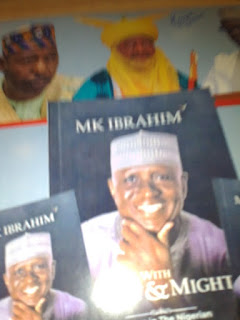
Saturday, 19th March 2022 was indeed a good day for Mohammed Kawu Ibrahim, popularly known as M.K. Ibrahim, or simply 'MK'. It was the day he formally launched his 460 page book with 18 chapters, titled 'With Heart & Might'. The book is a lucid chronicle of MK's exploits for 33 years in Nigeria's foreign service. Eminent citizens, including myself were there to support him. Some of the eminent persons present are:

*HRH Aminu Ado Bayero - Emir of Kano

*Prof. Ibrahim Gambari - Chief of Staff to the President

*Sen. Adamu Bulkachuwa - Chairman Senate Committee on Foreign Affairs

*Amb. Sani Bala - ED Savannah Centre for Diplomacy, Democracy & Development (SCDDD)

L-R: Prof. Babagana Zulum (Governor of Borno state), HRH Aminu Ado Bayero (Emir of Kano) & Prof. Ibrahim Gambari (Chief of Staff to the President). Inset: M.K. Ibrahim on the cover of his book

*Amb. Brownson Dede - Book reviewer

*Ahmed Rufai Abubakar - DG National Intelligence Agency (NIA)

*Amb. Shinkaiye - President, Association of Retired Ambassadors in Nigeria (ARCAN)

*Gabriel Aduda - Permanent Secretary, Ministry of Foreign Affairs

*Amb. Jibrin Chinade, MFR (Represented by daughter, Barr. Chinade)

*Amb. Ayewo  

Chapter 1 discusses his brief sojourn as an 'accidental banker' before he found his calling in the foreign service. Chapter 2 is about the beginning of his career, when he encountered teething problems of eating 'geisha' with bread for dinner often and living virtually in his car in Lagos because of accommodation problems! He describes the 'new dawn' in chapter 3 (1999 to date), with the Ministry of Foreign Affairs adjusting to the Presidential system of government. The Ministry trying to balance the needs of Legislators with what the Executive wants: The era of 'legislative diplomacy'.

Another area of concern is the high percentage of non-career diplomats deployed to foreign Missions - sometime they constitute over 60% of heads of Missions. This dampens the enthusiasm of career diplomats who might have been waiting for decades to become Ambassadors and get posted to foreign Missions...MK writes bluntly and frankly on every issue without being offensive.

MK also addresses the challenge of illegal immigrants in the diaspora. While in Gabon, he encountered many Nigerian illegal immigrants who were 'products' of the Nigerian civil war. He laments the fact that no Nigerian Mission can repatriate even five Nigerians. Poor funding makes this impossible. However, in Libya the government had to hurriedly repatriate at least 24,000 Nigerians!

MK also recorded humorous and painfully tragic events. Adiza, his daughter, died while MK was serving in Brussels. The more tragic detail is that the death was caused by a leaking gas pipe in his abode! This was definitely a fall-out of the inability to maintain government property at home and even abroad. These details are in pages 201-206 of the book.

About MK's sojourn in Libya. He believes that in-spite of all his faults, Mu'ammar Gaddafi was a hero. His disappointment towards the end of his life was how he was betrayed by African countries. On the whole, MK's frank memoir expounds the dream of a competent and professional foreign service officer/diplomat. So far ten such books have been written by retired diplomats. Many times during the event, those who had not written theirs were encouraged to do so. Congrats once more, MK...

                                              Dr. Dayo Oluyemi-Kusa @ the event
  

Saturday, 5 March 2022

MAKING GENDER A LIVING REALITY

 The title of this Blog post was the theme of the three-day training programme between the 1st and 3rd of March 2022. I was a valued member of faculty for this compact method of imparting knowledge to Security Officers in diverse Federal Government Agencies. The sessions were hosted by the National Centre for Women Development (NCWD) in collaboration with Country Associates Network (CANET).

                            Dr. Dayo Oluyemi-Kusa: Facilitator @ the training/workshop

Some of the facilitators are:

*Hon. (Dr.) Asabe Vilita Bashir - DG NCWD
*Princess Jumai Idonije - SA Technical to Minister of Women Affairs/Former Director of Training, NCWD
*Dr. Dayo Oluyemi-Kusa - Conflict Transformation Strategist/Gender Specialist
*Mrs. Ebiyere Emezue - Director, Training & Development, NCWD
*Ms. Mimidoo Achakpa - Development Worker/IANSA Women's Network Nigeria
*Mrs. Mute Olori - Certified John Maxwell Coach

L-R: Dr. Dayo Oluyemi-Kusa & Princess Jumai Idonije (SA Technical to Minister of Women Affairs)

An array of topics was covered within three days:

*Mediation techniques for Security Officers
*Gaps in women's participation in the security sector
*Gender equality, Covid-19 & national development
*Is equal participation of the sexes in unpaid work an impossible dream?
*Active listening for effective communication
*Gaps in women's participation & representation in Small Arms & Light Weapons (SALWs)
*Result-based management
*Proposal writing
*Introduction to gender studies

The high point of the training/workshop was the visit of the trainees to the Women's Hall of Fame within the premises of NCWD. There, some of them saw on display, probably for the very first time, the photographs of icons like Dr. (Mrs.) Maryam Babangida (Fmr. First Lady/Initiator of the 'Better Life for Rural Women Programme' -  BLFRW; Dr. (Mrs.) Dora Akinyili (Fmr. DG National Agency for Food & Drug Administration & Control - NAFDAC; Dame Virginia Etiaba (Fmr. Governor of Anambra State/First female Governor in Nigeria); etc. 


Event Banner showing DG NCWD, Hon (Dr) Asabe Vilita Bashir


Wow! The above was quite a lot to cover in three days! But we did it and the trainees were the better for it. The Security Officers now have certificates to show for their effort.
Congrats to NCWD and CANET...  

Related Links

*The hidden epidemic of brain injuries from domestic violence (DV)    nytimes.com

*The re-definition of masculinity is playing out in the fight between Zelensky (Ukraine) and Putin (Russia)    qz.com

*Women building a sustainable future: Fighting back the desert amid Niger's refugee & climate crisis    news.un.org

*Mentoring & teaching women with disabilities in Universities    timeshighereducaton.com

*Contextual learning: Linking learning to the real world    timeshighereducation.com

*Gender and peaceful masculinities: Religion & psycho-social support amid forced displacement    usip.org

*Google offers free tools that enable businesswomen to be seen online    grow.google

*Rebels, victims, peace-builders: Women in Cameroon's Anglophone conflict      crisisgroup.org

*Why women seem to have better Covid-19 outcomes than men: The answer is oestrogen    time.com

*Men twice as likely to be highly paid than women, new gender equality score card shows     womensagenda.com.au

*Gender-sensitive pedagogy for early childhood education (GRP4ECE)   https://lnkd.in/g9tvHzFt

*Betty White: Imagine living 99 years and an entire country collectively agreeing it wasn't long enough    https://lnkd.in/eqGyVJB3

*Maya Angelou becomes first black woman on a quarter (coin)    nytimes.com

*What dolphins reveal about the evolution of the clitoris    newscientist.com

*The state of burnout for women in the workplace    mckinsey.com

*Promoting women's political participation from quotas to parity    africa.unwomen.org

*Study says motherhood is equivalent to working 2.5 full-time jobs    https://lnkd.in/ghXnF8XR

*India's Cabinet approves raising minimum age of marriage of women from 18 to 21 years    independent.co.uk

*Gender equality is central to technology and democracy    foreignpolicy.com

*Applying a gender lens to Security Studies    iar_gwu.org

*Bhutan: Country where only women are allowed to own property    sunday.roast.media

*Nigeria's all female law firm hopes to make big changes in the legal system    bbc.co.uk

*Insecurity: Women important in peace-building processes    punchng.com

*Re-imagining women's space: Gender and power dynamics in African religion    link.springer.com

*Homicide is a leading cause of death in pregnant women: Black wome @ greatest risk    thelily.com

*Tanzania lifts ban on pregnant school girls: They can now return to school     thecitizen.co.tz

*Case studies on women and candidate selection in African liberal parties by Samson Itodo    facebook.com

*We need to stop gas-lighting women about money    fastcompany.com

*Gender inequality in children's entertainment    inews.co.uk

*Guideline spousal support and the female payer: Female payer cases often have an emotionality to them that can bring about larger gender issues    americanbar.org

*23 million females married as children in Nigeria    ait.com

*Elevating gender equality in Covid-19 economic recovery: The time to close the gender gap has increased to 135.6 years from 99.5 years    genderequalitycovid19recovery.com

*How to navigate the role of  'Accidental Mediator'    wearethecity.com

*What Mediators should know about Conflict Management Coaching    podbean.com

*Bias against women: A Constitution to guarantee equality and freedom    dailytrust.com

*Breaking the bias in candidate selection in African Political Parties by Samson Itodo    idea.int

*It's still a man's world: The 25 biggest European Banks by assets have seen 22 changes in CEO Chair over the past few years. 21 of these 22 jobs went to men    reut.rs/3MDiEKx

*Community workers break the odds to help survivors of GBV in DRC   unhcr.org

*Only 21% of government Ministers were female as of September 2021, with only 14 countries having 50% or more female Cabinet members. Assuming current trends persist, gender parity in Ministerial positions will not be realised until 2077, with an annual growth rate of only 0.52%    unwomen.org

*How women Parliamentarians enhance and advance gender equality and sustainable development    stories.undp.org


Saturday, 19 February 2022

REPOSITIONING THE INSTITUTE FOR PEACE & CONFLICT RESOLUTION (IPCR) FOR THE NEXT LEVEL

It was indeed an honour to be invited as a resource person between the 14th and 15th of February 2022 to the 'Strategic Management Retreat' of the Institute for Peace & Conflict Resolution (IPCR), Abuja. The retreat was held at De Peace Hotel & Suites, Ilorin, Kwara state. IPCR is the Federal Government's think tank for non-kinetic conflict transformation in Nigeria. I retired from IPCR in 2010 (12 years ago), as the very first and only female Director to date! It was quite pleasant for me to see many of my mentees, some of whom I sat on the interview panel for their recruitment, now with grey beard! (lol). Many of those I trained are now Directors and Deputy Directors... 

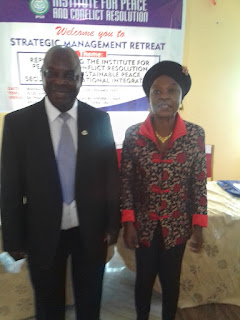
             Photo L-R: Dr. Bakut tswah Bakut (DG, IPCR) & Dr. Dayo Oluyemi-Kusa

In his welcome address, the DG, Dr. Bakut tswah Bakut said he was delighted to see former DGs and Directors after so many years. He complained about the under-funding of IPCR. He also observed that some offices within the office complex, in the section occupied by the African First Ladies Peace Mission (AFLPM), were locked up, in spite of the fact that such spaces were needed to accommodate members of staff of IPCR. 

Some of the participants are:

*Representative of the Minister of Foreign Affairs - Amb. Samson Itegode

*Acting Chairman, Governing Council, IPCR - Rt. Hon. Alex Ukang

*Prof. Sani Lugga - Wazirin Katsina/Guest Speaker

*Prof. Sunday Ochoche - 1st DG, IPCR

*Prof. Joseph Golwa - 2nd DG, IPCR

*Prof. Oshita Oshita - 3rd DG, IPCR

*Dr. Bakut tswah Bakut - Current DG, IPCR

*Dr. Pogu Bitrus - Former Director, IPCR/President, Middle Belt Forum (MBF)

*Dr. Dayo Oluyemi-Kusa - Former Director, IPCR/Independent Conflict Transformation Strategist

*Jonathan Yisa - Former Director, IPCR (Admin)

*S.O. Amin - Former Director, IPCR (Admin)

The high point of the retreat was the courtesy call on the Emir of Ilorin, Alhaji Sulu Gambari. The Emir lamented the fact that traditional rulers, whom he preferred to address as 'natural rulers' do not have a Constitutional role. He said there could be value added to the conflict transformation processes in many areas if he and his colleagues had constitutional roles.

In my intervention, I highlighted the fact that the project I conceptualised as Director, External Conflict Prevention & Resolution (ECPR) - 'Post-conflict peace-building in Africa' was the first to be approved by the National Assembly then. All other departments had to latch on to my project and make proposals relevant to my sphere, so they could get a' piece of the action' - some largess (in monetary terms) from my departmental project vote to enable them execute some form of project in their respective departments. I wish to put it on record that when I made this assertion at the retreat, I waited for a few seconds to enable anyone who had a contrary re-collection of what transpired then to speak up or keep his/her peace forever. Nobody took up the challenge. The video of my speech is available...

Besides, I alluded to the fact that I had 'bragging rights' beyond IPCR. I told the audience that I was a foundation member of staff of Lagos State University (1984), where I rose to the position of Senior Lecturer. Between 1994 and 1997, I was the first female Head of Department (HOD) of Political Science. At the end of my term as HOD, I set up the Centre for Refugee & Conflict Studies (CRCS) in 1997. For my effort, LASU appointed me the first Director of CRCS. Before LASU, I was a journalist. I was the first National Assembly Correspondent of the Guardian Newspaper at inception in 1983. I met my husband, Femi Kusa, a veteran journalist in the Guardian Newsroom - he was then the News Editor. The bottom line is that I have traversed Advertising, Journalism, Academia, Public Service and now Civil Society. I said all these about myself for a purpose: to inspire the female research staff to 'shatter (break) the glass ceiling'. I would like to see the next female Director in IPCR (after me) very soon. Beat me to it and be the first female DG...   

There was much discussion about 'political will' at the retreat. I pointed out he fact that there could be no political will without 'political pressure' from civil society actors. IPCR could be a veritable platform for such pressure that would benefit the populace. Furthermore, I advised the researchers to have impressive digital footprint(s) that would make them visible worldwide. I suggested that henceforth,  retired Research Directors and DGs who are willing and available to teach courses at the Peace Academy, housed by IPCR, should be invited to contribute to the expansion of knowledge. The 'Gender Unit' in IPCR should remain a stand-alone entity and not 'merged' with any other Unit/Directorate in view of the fact that gender is a veritable cross-cutting issue... Because government has a preponderance of the use of force, she takes responsibility for keeping Nigeria and Nigerians safe. Civil society actors are limited to the non-kinetic arena: advisory role/activism. The extensive potential of IPCR is yet to be actualised...  
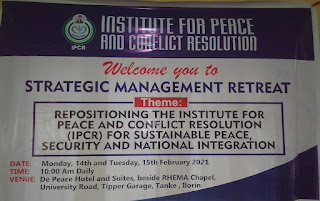
                                                               Banner for the Retreat

In his keynote address titled: 'Repositioning IPCR for sustainable peace, security & national integration', Prof Sani Lugga was worried that reports of many 'Probe Panels','Commissions of Inquiry'.etc.are gathering dust on numerous shelves, un-implemented.Such reports need to be implemented. The idea of using mercenaries to fight insurgents was accepted in principle some years ago, but it was later dropped. He believes mercenaries could be useful in the fight against insurgency.

He suggested a change of name for IPCR: 'Nigeria's Institute for Peace'. He advocated for a 'Peace Fund' via an Act of the National Assembly that would ensure proper funding of IPCR. More offices should be opened in parts of the country. Kidnapping seems more lucrative now than cattle rustling: Simply kidnap the owner of the cattle, so that he/she would sell the cattle and bring the proceeds to the kidnappers! The 'contemporary causes of insurgency need to be further interrogated - poverty/unemployment/out of school kids (almajiris)/proliferation of SALWs/corruption/misuse of religion & ethnicity etc.

The representative of the Minister of Foreign Affairs, Amb. Samson Itegode, emphasised the fact that in addition to monitoring Constituency Projects executed by legislators, IPCR should participate in 'Peace Committees'.

Dr. Pogu Bitrus, President Middle Belt Forum, and former Director, IPCR was optimistic that insurgency could be tackled headlong with the necessary political will. He meticulously traced the origin and trajectory of discontent and insurgency in Nigeria. IPCR remains a veritable platform for continuous engagement with government to actualise the much needed peaceful co-existence in the country.

                 L-R: Prof. Sunday Ochoche (1st DG, IPCR) & Dr. Dayo Oluyemi-Kusa

In his paper, titled: 'Building stakeholders' capacity for peace policy & interventions: Appraising IPCR's roles & future pathways', Prof. Sunday Ochoche, the very first Director-General of IPCR would have liked a submission from IPCR, via the current DG, as regards the vision and challenges of the Institute. This would then form the basis for his critique. In the absence of the desired think piece from IPCR, Ochoche made the following assertion:

-IPCR is even more relevant now than in the year 2000 when it was established, because the scope of conflicts in Nigeria and beyond has expanded.

-When IPCR was established, the national capacity to contain conflicts was at its infancy. Now, the 'conflict transformation industry has ballooned!'.

-IPCR must stand out and establish itself as a credible brand.

-Some of the recommendations of the Oransaye Report are questioning IPCR's existence. Why is government querying itself?

-IPCR has  no business remaining under the Ministry of Foreign Affairs. IPCR should be returned to the Presidency.

-IPCR should be strategic in the selection of her partners, while assessing herself vis-a-vis capability and comparative advantage.

-It's un-necessary to set up offices in the 774 local government areas. IPCR might stretch herself too thin.

-IPCR must first develop her capacity, while doing away with civil service mentality.

-Peace work is not for anyone who just needs a desk assignment.

-The Department of Security Studies should be able to analyse some of the contemporary issues. For example, how do Nigerian Army equipment get into the hands of insurgents?

-Being an 'elder' is not enough to make one a 'peace-maker' or 'conflict manager'.

-There should be Conflict Impact Assessment of all projects.

-IPCR should develop more independent funding sources.

Prof. Joseph Golwa, the second DG of IPCR presented the paper - 'Mediatory & Advocacy interventions towards sustainable peace, security & integration: The way forward for IPCR'. The proposed International Mediation Centre (IMC), mooted by IPCR, is a welcome development. The attributes of a good Mediator are relevant here. Golwa mentioned the many interventions in conflict zones. He shared the successful and not-so-successful stories...

Some members of staff wanted a more streamlined career training plan for IPCR. 

The third DG IPCR, Prof. Oshita Oshita, discussed 'Research strategies for building sustainable peace, security and national integration: The roles of IPCR'. He said that institutional self-assessment must be authentic. The academic relationship with University of Ilorin should be sustained. Solving research problems adds to knowledge. The major elements of research are: identification of the problem, methodology, data gathering, etc. Peace-building entails constructive relationship with the community. Oshita recommended that the mandate of IPCR should be continually interrogated. The UN functional capacity assessment of IPCR should be re-visited. IPCR should reel out Policy Briefs, Occasional Papers, Monographs, Books, etc. Research is simply doing over and over again using certain procedures. Research is both an art and a science. Research should be systematic, it should have a practice code, a definite procedure, a code of ethics, etc. Such research should be targeted at critical end users.

What then are the major recommendations from the retreat?

*IPCR is more relevant now than ever before.

*Government should fund research more in IPCR. The establishment of a Peace Fund via an Act of Parliament is desirable.

*IPCR should identify and leverage on her comparative strategic advantage.

*The Strategic Conflict Assessment (SCA) of  Nigeria should be conducted more regularly.

*Qualitative & quantitative research should exist side by side. Research activity should be connected with the end user. A definite House Style is needed in IPCR.

*The capacity building of members of staff is germane to growth in IPCR.

*IPCR should be excised from the Ministry of Foreign Affairs and returned to the Presidency.

*IPCR needs to expand to other parts of Nigeria as and when necessary.

*Without political pressure, political will may remain an illusion.

On the whole, I had a fulfilling outing in Ilorin at the 2022 IPCR Strategic Management Retreat. Kudos to the DG and his capable team for pulling off this impressive parley...   

                                   L-R: Dr. Bakut tswah Bakut & Dr. Dayo Oluyemi-Kusa    


Wednesday, 26 January 2022

CONFLICT PREVENTION VIA UNIVERSAL HEALTH COVERAGE

My niche, conflict transformation, informs the perspective from which I see events around me. I was consistent as regards the prism through which I perceived the summit held in Abuja on the 16th of December, 2021. The theme of the parley was 'Universal health coverage (UHC): Putting health & the health sector on the political front burner'. Chief (Mrs) Moji Makanjuola, MFR, Chair, UHC 2023 Forum, was the convener. Since her sojourn at the Nigeria Television Authority (NTA), anchoring 'Health Reports' and other programmes, ('Bridges' post retirement), I knew she was up to something formidable like the UHC 2023 Forum.

My take is that if inclusiveness is the watchword as regards UHC, then vulnerable groups, which include women, children, the aged, persons living with disabilities (PLWDs) would be captured. When the critical mass of the citizenry is healthy, then they can function at maximum capacity in the society. When citizens can function maximally, then the level of productivity in all sectors of the society is enhanced. When productivity is enhanced, then the volume of the 'cake' baked at all levels is pleasing -  scarcity, hunger and dis-affection may then be effectively tackled. This could lead to greater harmony and indeed less conflict in the society. Hopefully, then, no one would be left behind...or at least, majority of the populace would have been enclosed in the safety net of UHC...

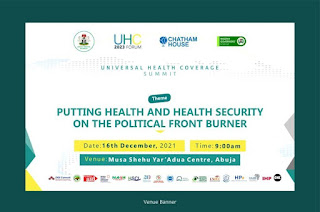
                                                           The banner for the Summit

Did I digress earlier? Apologies. Back to the summit. The following are the Summit themes:

*Putting health and  health security on the political front burner: What we have learned, what can we do differently?
-Taking advantage of the election period to advance health policy thrusts: What has international experience taught us?
-A critical appraisal of Nigeria's health challenges & promising policy options.
-Towards articulating a health agenda & obtaining commitments for enhanced prioritisation of health in Nigeria

*Subsidising health cost in Nigeria: Successes, gaps & the next frontier.
-Implementation of the BHCPF: How far have we gone? What else should we do?
-Expanding health insurance coverage to the poor through equity fund: Accomplishments & impediments.
-Using donor funds to subsidise health cost: The Christian Aid experience.
-Subsidisation for financial protection: What do we want from the political class?

*Forging consensus & building a coalition towards putting health on the political front burner.
-The role of donors, the media & civil society in putting health and health security on the political front burner.

Some of the participants are:

*Senator Bukola Saraki - President, 8th Senate, Nigeria
*Rep. Gov. Abdullahi Sule - Governor, Nasarawa state
*Rob Yates - Director, Global Health Programme/ED Centre for Universal Health, Chatam House
*Prof. Aliko Ahmed - Associate Fellow, Global Health Programme,Chattam House
*Sen. Dr. Ibrahim Oloriegbe - Chair, Senate Committee on Health
*Mrs. Moji Makanjuola - Chair, UHC 2023 Forum/Summit Convener
*Rep. Gov. Okowa - Governor, Delta state
*Dr. Olumide Okunola - World Bank/IFC
*Prof. Nasir Sambo - ES, NHIS
*Dr. Amina Dorayi - Country Director, Pathfinder
*Dr. Sam Agbo - FCDO
*Dr. Yusuf Yusufari - Bill & Melinda Gates Foundation
*Dr. Dayo Oluyemi-Kusa - Independent Conflict Transformation Strategist, Abuja
*Prof. Alli Mohammed
*Otun Adewale - Well-being Foundation
*Ms. Ene Ede - VAPP Coordinator, FCT
*Anu Rotimi - Rep. CSOs
 
Some of the highlights of the animated discussion are:

UHC can be used to address poverty. Nigeria is low to medium UHC. There should evolve a clear pathway for UHC. We need to end maternal and new born deaths via UHC. Primary Health Care (PHC) is critical to UHC. Less than 2% of the population covered under the NHIS in Nigeria. Any child born in Nigeria has approximately 36% productivity. Vulnerable groups fund & NHIS Authority Bill are being discussed. There should be effective linkage between primary, secondary and tertiary  health systems. Democratic nation-states have citizens with longer life span. Your vote affects how long you and members of your family live. Politics is a normative and subjective enterprise that affects health security. Free and fair elections have a positive effect on life expectancy.

Civil society needs to generate political commitment for UHC. Expertise on how to launch and sustain UHC reforms required. We need to share experiences from successful models. More public events, fora, etc. like UHC 2023 Forum need to spring up to call attention to the need for UHC. The political strategy to enhance UHC should also include round tables, briefings, media engagement, etc. We should use Chattam House rules in meetings, so that individuals can express themselves freely. We need to talk to incumbent governments and the opposition also. We should use the power of ideas to influence the idea of power. In Nigeria, population has out-paced economic growth. Public spending is constrained by insufficient funds. In a recession or pandemic, countries are forced to spend more on health. We need to block the health benefit black hole. The proposed 'Sugar Tax' should be given to he health sector. 

In my intervention, I called attention to the fact that health security is only a part of the whole gamut of human security, which is beyond perimeter fencing. We keep brandishing the concept of 'political will', but I know that we cannot have political will without 'political pressure' to do the needful as regards UHC. As a Political Scientist, I am particularly interested in the political economy of health care. Also as a Conflict Transformation Strategist, I strongly believe that some conflicts can be prevented in the society if we have inclusive UHC...

The NHIS boss reiterated the fact that the overall objective of the BHCPF is to ensure the provision of a basic minimum package of health services (BMPHS) to all Nigerians. But there are a number of challenges: Poor PHC facilities, advocacy, political will as regards the equity fund, financial management, Epidemiology, accreditation, digital technology, data/demographics, quality assurance, monitoring & evaluation, information/education/communication (IEC), enrollment, etc. UHC entails population/service/insurance coverage.

What then is to be done?

*There should be prompt release of BHCPF for sustainability.
*Advocacy to support SSHIAs beyond BHCPF wanted.
*Mandatory health insurance (HI).
*Increase in percentage disbursement to BHCPF.
*Massive creation of awareness about NHIS to the public.

What then are the policy options?

*We should strategically use the political season to call attention to the importance of UHC while soliciting the buy in of  politicians.
*UHC could be actualised via the NHIS.
*Digital technology is crucial.
*The political class has a crucial role to play. Investment in health should be increased. A minimum of 15% of the annual budget should go to the health sector.
*Civil society should continue to advocate for UHC.
*We should leverage socio-cultural nuances while calling attention to the importance of UHC. The role of traditional leaders as regards advocacy is crucial.
*A lobby group should constantly liaise with the National Assembly, Governors' Forum, etc.
*The cooperation of the mass media should be solicited for UHC advocacy.

Next steps

*The recommendations should be converted into a road map for the UHC Forum.
*An engagement strategy should be formulated.
*A draft template (Manifesto) should be written. This should include what we want to see in the health sector as regards UHC...

Impressive! The UHC 2023 Forum is definitely off to a terrific start. The tempo needs to be sustained. On my part, I am committed to advocacy for conflict prevention via UHC. Bravo to Mrs. Moji Makanjuola and her fabulous team...


Related Links

*How to build Africa's health care defense system by Akinwunmi Adesina   http://guardian.ng/news/how-to-build-africas-health-care-defense-system-akinwunmi-adesina/


Tuesday, 25 January 2022

WHAT WOMEN IN POLITICS WANT: MUSINGS FROM THE PROGRESSIVE WOMEN's CONFERENCE

The National Progressive Women's Conference was held at the International Conference Centre, Abuja, between the 18th and 19th of January, 2022. It was indeed an impressive spectacle to behold, a carnival of sorts, where 'sisters in politics' did not lose the essence of their gathering in one venue to discuss, analyse and proffer viable solutions to the numerous problems bedeviling women. The theme of the conference was: One voice, women uniting for progress. Why has the number of women in elective positions been on the downward spiral since 1999? There were many high profile delegates from the geo-political zones of Nigeria. Some of the dignitaries present are:

*Prof. Yemi Osinbajo - VP Nigeria

*Dr. Jewel Taylor - VP Liberia/Keynote Speaker

*Dr. (Mrs) Aisha Muhammadu-Buhari - First Lady, Nigeria

*Hon Stella Okotete - Convener

*Dr. Tijani Aliyu - Minister of State, FCT

*Dame Pauline Tallen - Minister for Women Affairs

*Hon. Umar Farouk - Minister of Humanitarian Affairs

*Barr. Sharon Ikeazor - Minister of State for the Environment

*Mrs. Titilayo Laoye-Tomori - Fmr. Dep. Governor, Osun State

*Sen. Florence Ita-Giwa

*Dr. Hajo Sani - Nigeria's Ambassador to UNESCO

*Senator Binta Masi Garba

*Mrs.Nchita Asabe - DG National Centre for Women Development (NCWD)

 *Senator Grace Bent

*Erelu Bisi Adeleye-Fayemi - First Lady, Ekiti State

*Mrs. Chioma Uzodinma - First Lady,

*Dr. Zainab Bagudu - First Lady,

*Dr. (Mrs) Ayade - First Lady, Cross River State

*Hon. Nkeiruka Onyejeocha - Deputy Chief Whip, House of Reps

*Hon. Olubunmi Ette - Fmr. Speaker House of Reps/1st & only female Speaker to date

*Dr. Justina Mutalele - Chair, JM Foundation

The objectives are:

*Embed gender mainstreaming in Party processes at the national, zonal and state levels.

*Amplify collective concerns for strategic positioning of women for political office.

*Converge Progressive Women into a unified voice for women's security & political growth.

*Educate, enlighten & empower (3 Es) Nigerian women for maximum utilisation of skills acquisition through a digital learning platform (DLP)

*Launch Progressive Women's Academy - a foremost digital learning platform.

*Attract a culturally diverse group of progressive women who will connect, educate, inspire and empower one another via mentoring and personal growth for collective development.

The high point of the conference was the unveiling of the 'Progressive Women's Academy' on a 'Free Learning Platform for Nigerian & African Women' by the wife of the President, Dr. Aisha Buhari. The aim is to train at least 20 million women in two years!

The themes are:

*Women political leaders in Nigeria: Leveraging networks to transform the political space.

*It's time to represent: Getting women elected into office

*Fiscal policies & interventions for women's economic empowerment

*One voice: Overcoming the challenges

*Embracing diversity & empowering the next female generation

*Defining women in the political space in a new decade 

*The role of women in security, governance & development

*The African woman, a beacon of hope

*Giving voice to women's visibility

*Overcoming adversity, obstacles & barriers

The Charter of demands from the conference was eloquently elucidated in the communique:

*There should be institutional reforms which take cognisance of the concerns of women.

*Fora for the interaction of women for progress are necessary.

*Mentorship for the next generation of female politicians needed.

*The 'Progressive Women's Trust Fund (PWTF)'should be set up to address the critical issue of feminisation of poverty and non-availability of campaign funds for women in politics.

*Consitution review committee should be set up. Affirmative action for women should be top on the agenda.

*A 'Lobby Group of Women' should be set up.

*There should be inclusivity for women at all levels.

*There should be at least 35% of all posts for women.

*There should be an increase in the number of women in the Board of Trustees (BOT) of the Party.

*There should be a comprehensive review of the APC Constitution.

Wow! What an ambitious basket of demands. From what I witnessed at the conference, these women are up to the task. Keep pushing ahead, ladies...

AFFIRMATIVE ACTION FOR WOMEN: LEGISLATION IS KEY

 On the 24th of January 2022, I was in the Studio of Boss 95.5FM, Asokoro, Abuja, to discuss what women want and how to enhance the participation/visibility of women in politics. At the outset, Itold my interviewers that the playing field in politics in Nigeria is not level. It is skewed in favour of men for many reasons.

                                  Dr. Dayo Oluyemi-Kusa (middle) with the Boss FM95.5 'crew'
 

I zeroed in on the reasons why statistics show that the number of women in elective and appointive posts has been declining since 1999. To be sure, the 2019 elections were the worst for women, in terms of the number who got into elective positions. Why is this so? Some of the reasons I gave were:

*Feminisation of poverty. Poverty seems to have a feminine face. Most women cannot afford the following for nomination forms: Presidential - N45m, Governorship - N22.5m, Senate - N7m, House of Representatives - N3m. You might say some Parties have reduced the cost of the forms or given it free to female aspirants. But the feelers I'm getting from the field is that these monetary concessions for women are in reality a liability. They are looked down upon within the Party because they got their forms free! They do not have a strong voice when important decisions are being taken. Many female politicians now say they would rather pay in full for the nomination forms in order to have a 'proper seat' at the table!

*Lack of internal Party democracy (IPD).

*Tokenism for women. The most prominent woman in the Party is usually the 'Women Leader'. Why can't a woman be the Chairman of the Party, VP, Publicity Secretary, etc?

*Stereotyping: Women often take care of welfare, including the food. Why does such such 'welfare' include' women as Financial Secretaries?

*Violence against women in politics (VAWiP). Physical violence is not the only form of VAW. There is verbal violence, violence via exclusion, etc.

*Patriarchy: This is the elephant in the room! We cannot wish patriarchy away overnight, it takes time for men to accept that women should also be seen and heard...

*The socialisation of girls into the society is limited by patriarchal values.

*Lack of legislation on affirmative action (AA). Legislation is necessary to give 'teeth' to AA. In order to attain 35% AA and go beyond this to parity, we need relevant legislation. This is where the initiative of Hon. Nkeiruka Onyejeocha, Deputy Chief Whip, House of Representatives comes in: 'A Bill for an Act to alter the provisions of the Constitution of the Federal Republic of Nigeria, 1999, to create additional special seats for women in the National Assembly'. I would slightly adjust the Bill because the average annual budget of the NASS is already humongous - N134b yearly! I would not support additional seats, but I would rather have the seats 'carved out' of the existing seats in the NASS.  

*There should be more safe spaces for women and girls at all levels of the society.

*The VAPP Act needs to be implemented more vigorously beyond the FCT.

The statistics are not impressive for Nigeria as regards the level of participation of women in politics:

-National average (Nigeria) - 6.7%

-Global average - 22.5%

-Africa regional average - 23.4%

-West Africa sub-regional average - 15%

With the numerous obstacles in the way of women in politics in Nigeria, the discussion would get more heated towards the 2023 elections...