Wednesday, 26 January 2022

CONFLICT PREVENTION VIA UNIVERSAL HEALTH COVERAGE

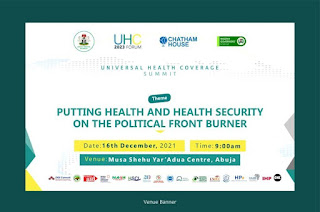
My niche, conflict transformation, informs the perspective from which I see events around me. I was consistent as regards the prism through which I perceived the summit held in Abuja on the 16th of December, 2021. The theme of the parley was 'Universal health coverage (UHC): Putting health & the health sector on the political front burner'. Chief (Mrs) Moji Makanjuola, MFR, Chair, UHC 2023 Forum, was the convener. Since her sojourn at the Nigeria Television Authority (NTA), anchoring 'Health Reports' and other programmes, ('Bridges' post retirement), I knew she was up to something formidable like the UHC 2023 Forum.

My take is that if inclusiveness is the watchword as regards UHC, then vulnerable groups, which include women, children, the aged, persons living with disabilities (PLWDs) would be captured. When the critical mass of the citizenry is healthy, then they can function at maximum capacity in the society. When citizens can function maximally, then the level of productivity in all sectors of the society is enhanced. When productivity is enhanced, then the volume of the 'cake' baked at all levels is pleasing -  scarcity, hunger and dis-affection may then be effectively tackled. This could lead to greater harmony and indeed less conflict in the society. Hopefully, then, no one would be left behind...or at least, majority of the populace would have been enclosed in the safety net of UHC...

                                                           The banner for the Summit

Did I digress earlier? Apologies. Back to the summit. The following are the Summit themes:

*Putting health and  health security on the political front burner: What we have learned, what can we do differently?
-Taking advantage of the election period to advance health policy thrusts: What has international experience taught us?
-A critical appraisal of Nigeria's health challenges & promising policy options.
-Towards articulating a health agenda & obtaining commitments for enhanced prioritisation of health in Nigeria

*Subsidising health cost in Nigeria: Successes, gaps & the next frontier.
-Implementation of the BHCPF: How far have we gone? What else should we do?
-Expanding health insurance coverage to the poor through equity fund: Accomplishments & impediments.
-Using donor funds to subsidise health cost: The Christian Aid experience.
-Subsidisation for financial protection: What do we want from the political class?

*Forging consensus & building a coalition towards putting health on the political front burner.
-The role of donors, the media & civil society in putting health and health security on the political front burner.

Some of the participants are:

*Senator Bukola Saraki - President, 8th Senate, Nigeria
*Rep. Gov. Abdullahi Sule - Governor, Nasarawa state
*Rob Yates - Director, Global Health Programme/ED Centre for Universal Health, Chatam House
*Prof. Aliko Ahmed - Associate Fellow, Global Health Programme,Chattam House
*Sen. Dr. Ibrahim Oloriegbe - Chair, Senate Committee on Health
*Mrs. Moji Makanjuola - Chair, UHC 2023 Forum/Summit Convener
*Rep. Gov. Okowa - Governor, Delta state
*Dr. Olumide Okunola - World Bank/IFC
*Prof. Nasir Sambo - ES, NHIS
*Dr. Amina Dorayi - Country Director, Pathfinder
*Dr. Sam Agbo - FCDO
*Dr. Yusuf Yusufari - Bill & Melinda Gates Foundation
*Dr. Dayo Oluyemi-Kusa - Independent Conflict Transformation Strategist, Abuja
*Prof. Alli Mohammed
*Otun Adewale - Well-being Foundation
*Ms. Ene Ede - VAPP Coordinator, FCT
*Anu Rotimi - Rep. CSOs
 
Some of the highlights of the animated discussion are:

UHC can be used to address poverty. Nigeria is low to medium UHC. There should evolve a clear pathway for UHC. We need to end maternal and new born deaths via UHC. Primary Health Care (PHC) is critical to UHC. Less than 2% of the population covered under the NHIS in Nigeria. Any child born in Nigeria has approximately 36% productivity. Vulnerable groups fund & NHIS Authority Bill are being discussed. There should be effective linkage between primary, secondary and tertiary  health systems. Democratic nation-states have citizens with longer life span. Your vote affects how long you and members of your family live. Politics is a normative and subjective enterprise that affects health security. Free and fair elections have a positive effect on life expectancy.

Civil society needs to generate political commitment for UHC. Expertise on how to launch and sustain UHC reforms required. We need to share experiences from successful models. More public events, fora, etc. like UHC 2023 Forum need to spring up to call attention to the need for UHC. The political strategy to enhance UHC should also include round tables, briefings, media engagement, etc. We should use Chattam House rules in meetings, so that individuals can express themselves freely. We need to talk to incumbent governments and the opposition also. We should use the power of ideas to influence the idea of power. In Nigeria, population has out-paced economic growth. Public spending is constrained by insufficient funds. In a recession or pandemic, countries are forced to spend more on health. We need to block the health benefit black hole. The proposed 'Sugar Tax' should be given to he health sector. 

In my intervention, I called attention to the fact that health security is only a part of the whole gamut of human security, which is beyond perimeter fencing. We keep brandishing the concept of 'political will', but I know that we cannot have political will without 'political pressure' to do the needful as regards UHC. As a Political Scientist, I am particularly interested in the political economy of health care. Also as a Conflict Transformation Strategist, I strongly believe that some conflicts can be prevented in the society if we have inclusive UHC...

The NHIS boss reiterated the fact that the overall objective of the BHCPF is to ensure the provision of a basic minimum package of health services (BMPHS) to all Nigerians. But there are a number of challenges: Poor PHC facilities, advocacy, political will as regards the equity fund, financial management, Epidemiology, accreditation, digital technology, data/demographics, quality assurance, monitoring & evaluation, information/education/communication (IEC), enrollment, etc. UHC entails population/service/insurance coverage.

What then is to be done?

*There should be prompt release of BHCPF for sustainability.
*Advocacy to support SSHIAs beyond BHCPF wanted.
*Mandatory health insurance (HI).
*Increase in percentage disbursement to BHCPF.
*Massive creation of awareness about NHIS to the public.

What then are the policy options?

*We should strategically use the political season to call attention to the importance of UHC while soliciting the buy in of  politicians.
*UHC could be actualised via the NHIS.
*Digital technology is crucial.
*The political class has a crucial role to play. Investment in health should be increased. A minimum of 15% of the annual budget should go to the health sector.
*Civil society should continue to advocate for UHC.
*We should leverage socio-cultural nuances while calling attention to the importance of UHC. The role of traditional leaders as regards advocacy is crucial.
*A lobby group should constantly liaise with the National Assembly, Governors' Forum, etc.
*The cooperation of the mass media should be solicited for UHC advocacy.

Next steps

*The recommendations should be converted into a road map for the UHC Forum.
*An engagement strategy should be formulated.
*A draft template (Manifesto) should be written. This should include what we want to see in the health sector as regards UHC...

Impressive! The UHC 2023 Forum is definitely off to a terrific start. The tempo needs to be sustained. On my part, I am committed to advocacy for conflict prevention via UHC. Bravo to Mrs. Moji Makanjuola and her fabulous team...


Related Links

*How to build Africa's health care defense system by Akinwunmi Adesina   http://guardian.ng/news/how-to-build-africas-health-care-defense-system-akinwunmi-adesina/


Tuesday, 25 January 2022

WHAT WOMEN IN POLITICS WANT: MUSINGS FROM THE PROGRESSIVE WOMEN's CONFERENCE

The National Progressive Women's Conference was held at the International Conference Centre, Abuja, between the 18th and 19th of January, 2022. It was indeed an impressive spectacle to behold, a carnival of sorts, where 'sisters in politics' did not lose the essence of their gathering in one venue to discuss, analyse and proffer viable solutions to the numerous problems bedeviling women. The theme of the conference was: One voice, women uniting for progress. Why has the number of women in elective positions been on the downward spiral since 1999? There were many high profile delegates from the geo-political zones of Nigeria. Some of the dignitaries present are:

*Prof. Yemi Osinbajo - VP Nigeria

*Dr. Jewel Taylor - VP Liberia/Keynote Speaker

*Dr. (Mrs) Aisha Muhammadu-Buhari - First Lady, Nigeria

*Hon Stella Okotete - Convener

*Dr. Tijani Aliyu - Minister of State, FCT

*Dame Pauline Tallen - Minister for Women Affairs

*Hon. Umar Farouk - Minister of Humanitarian Affairs

*Barr. Sharon Ikeazor - Minister of State for the Environment

*Mrs. Titilayo Laoye-Tomori - Fmr. Dep. Governor, Osun State

*Sen. Florence Ita-Giwa

*Dr. Hajo Sani - Nigeria's Ambassador to UNESCO

*Senator Binta Masi Garba

*Mrs.Nchita Asabe - DG National Centre for Women Development (NCWD)

 *Senator Grace Bent

*Erelu Bisi Adeleye-Fayemi - First Lady, Ekiti State

*Mrs. Chioma Uzodinma - First Lady,

*Dr. Zainab Bagudu - First Lady,

*Dr. (Mrs) Ayade - First Lady, Cross River State

*Hon. Nkeiruka Onyejeocha - Deputy Chief Whip, House of Reps

*Hon. Olubunmi Ette - Fmr. Speaker House of Reps/1st & only female Speaker to date

*Dr. Justina Mutalele - Chair, JM Foundation

The objectives are:

*Embed gender mainstreaming in Party processes at the national, zonal and state levels.

*Amplify collective concerns for strategic positioning of women for political office.

*Converge Progressive Women into a unified voice for women's security & political growth.

*Educate, enlighten & empower (3 Es) Nigerian women for maximum utilisation of skills acquisition through a digital learning platform (DLP)

*Launch Progressive Women's Academy - a foremost digital learning platform.

*Attract a culturally diverse group of progressive women who will connect, educate, inspire and empower one another via mentoring and personal growth for collective development.

The high point of the conference was the unveiling of the 'Progressive Women's Academy' on a 'Free Learning Platform for Nigerian & African Women' by the wife of the President, Dr. Aisha Buhari. The aim is to train at least 20 million women in two years!

The themes are:

*Women political leaders in Nigeria: Leveraging networks to transform the political space.

*It's time to represent: Getting women elected into office

*Fiscal policies & interventions for women's economic empowerment

*One voice: Overcoming the challenges

*Embracing diversity & empowering the next female generation

*Defining women in the political space in a new decade 

*The role of women in security, governance & development

*The African woman, a beacon of hope

*Giving voice to women's visibility

*Overcoming adversity, obstacles & barriers

The Charter of demands from the conference was eloquently elucidated in the communique:

*There should be institutional reforms which take cognisance of the concerns of women.

*Fora for the interaction of women for progress are necessary.

*Mentorship for the next generation of female politicians needed.

*The 'Progressive Women's Trust Fund (PWTF)'should be set up to address the critical issue of feminisation of poverty and non-availability of campaign funds for women in politics.

*Consitution review committee should be set up. Affirmative action for women should be top on the agenda.

*A 'Lobby Group of Women' should be set up.

*There should be inclusivity for women at all levels.

*There should be at least 35% of all posts for women.

*There should be an increase in the number of women in the Board of Trustees (BOT) of the Party.

*There should be a comprehensive review of the APC Constitution.

Wow! What an ambitious basket of demands. From what I witnessed at the conference, these women are up to the task. Keep pushing ahead, ladies...

AFFIRMATIVE ACTION FOR WOMEN: LEGISLATION IS KEY

 On the 24th of January 2022, I was in the Studio of Boss 95.5FM, Asokoro, Abuja, to discuss what women want and how to enhance the participation/visibility of women in politics. At the outset, Itold my interviewers that the playing field in politics in Nigeria is not level. It is skewed in favour of men for many reasons.

                                  Dr. Dayo Oluyemi-Kusa (middle) with the Boss FM95.5 'crew'
 

I zeroed in on the reasons why statistics show that the number of women in elective and appointive posts has been declining since 1999. To be sure, the 2019 elections were the worst for women, in terms of the number who got into elective positions. Why is this so? Some of the reasons I gave were:

*Feminisation of poverty. Poverty seems to have a feminine face. Most women cannot afford the following for nomination forms: Presidential - N45m, Governorship - N22.5m, Senate - N7m, House of Representatives - N3m. You might say some Parties have reduced the cost of the forms or given it free to female aspirants. But the feelers I'm getting from the field is that these monetary concessions for women are in reality a liability. They are looked down upon within the Party because they got their forms free! They do not have a strong voice when important decisions are being taken. Many female politicians now say they would rather pay in full for the nomination forms in order to have a 'proper seat' at the table!

*Lack of internal Party democracy (IPD).

*Tokenism for women. The most prominent woman in the Party is usually the 'Women Leader'. Why can't a woman be the Chairman of the Party, VP, Publicity Secretary, etc?

*Stereotyping: Women often take care of welfare, including the food. Why does such such 'welfare' include' women as Financial Secretaries?

*Violence against women in politics (VAWiP). Physical violence is not the only form of VAW. There is verbal violence, violence via exclusion, etc.

*Patriarchy: This is the elephant in the room! We cannot wish patriarchy away overnight, it takes time for men to accept that women should also be seen and heard...

*The socialisation of girls into the society is limited by patriarchal values.

*Lack of legislation on affirmative action (AA). Legislation is necessary to give 'teeth' to AA. In order to attain 35% AA and go beyond this to parity, we need relevant legislation. This is where the initiative of Hon. Nkeiruka Onyejeocha, Deputy Chief Whip, House of Representatives comes in: 'A Bill for an Act to alter the provisions of the Constitution of the Federal Republic of Nigeria, 1999, to create additional special seats for women in the National Assembly'. I would slightly adjust the Bill because the average annual budget of the NASS is already humongous - N134b yearly! I would not support additional seats, but I would rather have the seats 'carved out' of the existing seats in the NASS.  

*There should be more safe spaces for women and girls at all levels of the society.

*The VAPP Act needs to be implemented more vigorously beyond the FCT.

The statistics are not impressive for Nigeria as regards the level of participation of women in politics:

-National average (Nigeria) - 6.7%

-Global average - 22.5%

-Africa regional average - 23.4%

-West Africa sub-regional average - 15%

With the numerous obstacles in the way of women in politics in Nigeria, the discussion would get more heated towards the 2023 elections... 

Monday, 13 December 2021

THE IMPERATIVE OF NATIONAL UNITY

 The title of this Blog post was the theme of a national discourse in Abuja on the 1st of December 2021. The parley was the brainchild of the 'National Prosperity Movement' (NPM). Prof. Attaghiru Jega (former Chairman of INEC), delivered the keynote address, where he traced the history of Nigeria's federalism and zeroed in on the 1957 McPherson Constitution as the very first truly federalist one. Jega noted the following:

*Nigeria has a distorted/dysfunctional form of federalism, which ought to be reversed.

*There are certain threats to national unity which include ethno-religious and promordial identities, hate speech, misinformation & fake news, lopsided citizenship rights, dangerous and genocidal narratives about e.g. the farmer-herder crisis/the BH insurgency and irredentist militancy.

*Governance at the federal, state and local government levels leaves much to be desired.

*Nigeria is hurting and craving a better political recruitment process.

Jega recommended the following:

*Communities should uphold and protect the rule of law and citizenship rights: All citizens should have equal rights wherever they reside. A clause may be entrenched in the Constitution, stipulating the qualification for residency.

*There should be focused and targeted programmes of socialisation in schools to instill core values in the students. The content of the 'Civics' curriculum needs to be stepped up. There should also be citizenship and leadership training programmes.

                                                      Dr. Dayo Oluyemi-Kusa @ the event

Other speakers were: Dr. Kayode Fayemi (Governor of Ekiti state), Prof. Bayo Olukoshi (Director of Africa & West Asia of the International Institute forDemocracy & Electoral Assistance - IDEA), Dr. Amina Salihu (Senior Programme Officer, McArthur Foundation), Ms. Ene Ede (Gender Activist/VAPP Coordinator, FCT), Dr. Nwosu, Prof. Jideofor Adibe.

In my intervention, I talked about the need to effectively include vulnerable groups like women, PLWDs, etc in the governance process. Safe spaces should be provided for them because the playing field is not level. I also said that the indigene today was the migrant yesterday. Both indigenes and settlers are citizens of Nigeria. Therefore the issue of citizenship rights needs to be further interrogated...

  
                       L-R: Prof. Bayo Olukoshi (Director IDEA - Africa & West Asia) & Dayo.


Dr. Kayode Fayemi said there's nothing heroic in dying for a cause dialogue can fix. It's better to jaw-jaw than to war-war. No country was created as a united entity at the outset. Most countries are forms of mergers and acquisitions like Nigeria. Initial conditions are never perfect. Disunity is not a fatalistic condition. In the face of challenges, we must put the issues that affect us in better perspective. Unity  benefits from horizontal and vertical solidarity. Solidarity should not sideline professionalism, inter-group or inter-generational cohesion. Fayemi then launched 'The Nigeria Agenda for Unity, Prosperity & Equity'. He gave a red card to all negative agenda in order to stabilise Nigeria on an even keel.

What can I say? If we could all start over, we could indeed have a relatively united Nigeria...


Tuesday, 23 November 2021

THE AFRICAN FIRST LADIES PEACE MISSION

On the 22nd of November 2021, the 9th Summit of the African First Ladies Peace Mission was held at the Conference Hall of the Presidential Villa, Abuja. At least twenty First Ladies across Africa were present, while others were represented. I was there live! It is indeed heart-warming that the First Lady of Nigeria, Dr. Aisha Mohammed-Buhari is hosting the meeting at this critical time when many African countries, including Nigeria are in turmoil as a result of insecurity resulting from insurgency, farmer-herder crisis, kidnapping, criminality, rural banditry, etc

Photo above L-R: Ms. Ene Ede (VAPP Coordinator FCT), Dr. Dayo Oluyemi-Kusa & Alhaji Lai Mohammed (Minister of Information)
                               Photo above: Some dignitaries @ the event. Dayo is 5th from left

It is instructive that the President in his speech at the occasion said that 'women are well placed in the society to evolve strategies for mitigating conflict because they know where the shoe pinches - women and children are usually the greatest casualties of conflict/war...' At the post-summit dinner, funds were raised for a brand new edifice to house AFLPM in Abuja. We all look forward to the communique which would summarise the First Ladies' suggestions. Lest I forget, congratulations to Nigeria's First Lady for being elected the next President of the AFLPM...


Saturday, 30 October 2021

CLIMATE CHANGE & INSECURITY IN NIGERIA

 'Climate change (CC) as a security threat in Nigeria' was the subject matter for discourse at Sandralia Hotel, Abuja between the 27th and 28th of October 2021. The parley was hosted by Friedrich Ebert Stiftung (FES) in collaboration with Coalition for Socio-Ecological Transformation (COSET). The meeting is a prelude to COP 26 - 26th iteration of UN CC Conference of the Parties holding in Glasgow between 31st October & 12th November 2021. The sub-themes were:

*Assessing CC & armed conflict 

*Gender, youth & CC

*CC & food sovereignty 

*CC & human security (HS) 

*State & non-state actors' responses to CC & security

                                                               Dr. Dayo Oluyemi-Kusa

*Dr. Daniel Mann - Resident Representative, FES
*Prof. A. N. Gambo - VC Karl Kumm University, Vom 
*Rinmicit Aboki - Climate Change Specialist
*Rev. Fr. Edward Obi - Catholic Institute of West Africa, Port Harcourt
*Oseloka Obaze - MD Selonnes Consult, Awka
*Dr. Aliyu Barau - Bayero University, Kano
*Dr. Dayo Oluyemi-Kusa - Conflict Transformation Strategist, Abuja
*Olumide Idowu - Youth Focal Point @ UNDP Small Grants Programme
*Samuel Wakdok - Economist & Fiscal Sector Researcher
*Ken Henshaw - ED, We The People, Port Harcourt
*Evelyn Ugbe - Head Partnerships/Grants, Women Environment Programme
*Dr. Suwaiba Said Ahmad - Bayero University, Kano
*Titilope Ngozi Akosa - ED, 21st Century Issues
*Dr. Idris Ali 
*Dr. Lohna Bonkat-Jonathan - National Institute for Legislative & Democratic Studies, NASS
*Florence Ibok Abasi - Programme Manager, Stakeholder Democracy Network 
*Dr. Elizabeth Aishatu-Bature - Nigeria Defence Academy
*Chinma George - Environmental & Climate Change Specialist
*Tijah Bolton - Head of Programmes, Policy Alert
*Dr. Sunday Adejoh - Nigeria Defence Academy
*Salaudeen Hashim - Conflict Advisor, CISLAC 
*Dr. Ejike Madu

                   L-R: Dr. Ejike Madu, Dr. Joseph Ochogwu, Dr. Dayo Oluyemi-Kusa, Prof. Gambo

Issues of concern were:

*The contribution of the fast shrinking Lake Chad to insecurity.
*The 'new' AK-47-carrying herders in contrast with peace loving herders of yore who lived in harmony with sedentary farmers.
*Enhancing community resilience in the face of CC-induced conflict.
*Un-governed spaces as fertile ground for CC-induced conflict.
*Human-induced environmental degradation.
*The fact that when very old and relatively young trees are felled, unwanted carbon dioxide is released into the air.
*The uncomfortable intersection between CC, environmental degradation & conflict.
*How to transcend from negative to positive peace in affected communities.
*Restoration of indigenous trees through irrigation-free concepts.
*How to mainstream climate-smart agriculture through R&D - e.g. hydroponics, etc
*Interrogating the intersection between the National Livestock Transformation Plan (NLTP) & the Great Green Wall (GGW).
*UN 'RED' is donor driven and he who pays the piper dictates the tune. Therefore donor-dependent NGOs/CBOs sometimes engage in 'research' and 'advocacy' that's irrelevant to their communities.
*Environmental matters remain on the exclusive list. The Constitution needs to be amended to embrace the 'democratisation' of intervention in the environment, so that states and local governments would have a grater say/stake.
*Alternative Dispute Resolution (ADR) in the environmental sector.
*Conversion of salt water to fresh water.
*Damage caused by soot in Port Harcourt.
*Effective use of indigenous & local knowledge (ILK) in the environmental sector.
*The vexed issue of limited access to land because of insecurity.
*CC is a problem multiplier: force migration, affects women and men differently, feminisation of poverty, flooding, health challenges for women via CC: e.g. early menopause.
*River Benue drying up.
*More action required on 'NAP on CC'.
*Minimising carbon footprint.
*How to make more 'Keke Napep(s)' use solar energy.
*Internally Displaced Persons (IDPs) as a result of CC.
*Gender Based Violence (GBV) as a result of CC
*High warming rates in semi-arid regions: Number of infectious diseases expected to rise.
*Human security dimensions of CC - health, education, etc
*Food Sovereignty (FSo) vs Food Security (FSe). FSe does not necessarily guarantee FSo. This is because you may have enough food to put in your mouth to put hunger at bay - FSe. But is the food nutritious and do you have choice as expected in FSo? For example, Meals Ready to Eat (MRE) in the Military is highly nutritious, containing all the necessary vitamins and minerals - FSo?
*Mapping conflict as a result of CC.
*Peace Journalism/Conflict Reporting as regards CC.
*Negative effect of policy somersault in the environmental realm.
*Importance of Environmental Impact Assessment (EIA) for all projects.
*Wanted: National Resiliency Policy (NRP).
*Ecological Fund & corruption.
*Need for a multi-disciplinary approach in the environmental sector.
*State actors vs non-state actors in the environmental sector.

Some recommendations:

*ADR needs to be more rigorously deployed in the environmental sector.
*The Lake Chad should be 're-hydrated'.
*The farmer-herder crisis is CC-induced. Ethno-religious interference should be minimised.
*Environment should be expunged from the exclusive list in the Constitution.
*The Land Use Act (LUA) should be re-evaluated.
*There should be more government presence in currently un-governed spaces.
*Indigene-settler issue should become a Constitutional matter.
*Climate-smart agriculture should be encouraged.
*The GGW should be interrogated alongside the NLTP.
*Technology fo converting salt water into fresh water needed.

The above recommendations are not comprehensive. The conversation continues...

                                                             The conference banner...

20th January 2022

POST-COP26: GAINS, DISAPPOINTMENTS & MISSED OPPORTUNITIES FOR AFRICA

It's only logical that FES holds a post-COP 26 meeting, having held a pre-meeting in November 2021. The meeting held on the 20th of January was a mini post-COP 26 analysis.

Some of the participants are:

*Dr. Daniel Mann - Resident Representative FES
*Dr. (Mrs) Abiola Awe - Director, Dept.of Climate Change, Federal Ministry of Environment
*Dr. Dayo Oluyemi-Kusa - Independent Conflict Transformation Strategist, Abuja/
*Priscilla Achakpa -
*Rev. Fr. Obi Edward - 
*Ken Henshaw - 
*Cadmus Atake Enade
*Tito Uzomah/Chinma George/Zainab Yunusa/Olumide Idowu/Rinmicit Aboki/Anne-Marie A - Told their stories from COP26
*Titi Akosa - ED 21st Century Issues
*Hauwa Mustapha - 
*Seyi Adebote

The COP26 analysis was approached from many angles: Gender, government, capitalism, labour, Africa, Nigeria, etc. There are disappointments for civil society in COP26. Market mechanism will not solve the climate challenge. Net-zero postulations defer actions, they are simply functional stipulations. It was an exclusionary conference, only two delegates per Mission allowed. We need to phase out fissil fuel in Africa. But how can we do this when many countries, including Nigeria depend on it for survival? Climate change of people more desirable than COP26?

We need more nature-based solutions and indigenous knowledge (IK) to CC. Other issues raised: Agro-electricity is useful, how realistic are binding global emission levels?, how can countries in the global south flourish in spite of CC?, CoSET should champion a Nigerian corps.

Stories/experiences from COP26:

-Difficult to get accreditation.
-Financing for action panel sessions inaccessible.
-Poor organisation of Nigeria's team/youth working groups.
-Youths need training in Negotiation.
-Financial commitments from UK, Canada sometime not fulfilled. We need to strategise about how to access these funds.
-From COP27, Nigeria should showcase relevant innovation like other countries.
-Many participants were quite intrigued by the side events.

Titi Akosa brilliantly 'unpacked' Article 6 for the audience.

Discussion in the 'alternative space'. What caused CC in the first place? The market. Therefore, can market solutions effectively tackle CC challenges? The private sector (PS) says 'no free money for loss & damage'. Is the 1.5 degreesC benchmark scientifically based? The PS is sometimes more powerful than government. Clean Development Mechanism (CDM) under the Kyoto Agreement. Africa has less than 3% of the emission. G7 has 97%. PS has introduced 'trading in pollution'. This is a 'false' solution. The PS is creating projects in Africa that would absorb their emissions (carbon capture & storage/de-engineering).

There are number of engagements under Article 6:

-Voluntary engagements - Internationally Transferred Migration Actions (ITMAs)
-Nationally determined contributions (NDCs0
-Common But Differentiated Responsibilities - CBDR

How does Nigeria benefit from Art 6?

-In any project, take care of the human beings, first. 
-Pursue the provision of clean energy vigorously.
-Get the emission reduction certificate that can be traded.
-Think about very BIG projects.
-Divest from fossil fuel.
-Think out of the box.
-Invest more in clean energy.

The 'Just Transition (JT) Declaration'

It started in the 1990s in North America. Coal was to be phased out because of environmental pollution. The workers worried about suddenly losing their jobs. Workers insisted on a gradual transition process which would ensure they don't get suddenly thrown into the labour market. Workers re-trained and formed the Global Workers' Unions (GWUs). Workers ensured social protection was on the cards for them. Then came the Movement for Just Transition in Brazil, etc. There was also Climate Action for Jobs Initiative (CAJI).

Nation-states might not be committed to commitment. Some countries promised $100b annually for the mitigation of CC. JT should be included in the NDC. 

Youth engagement

There have been two youth engagements since 2017. For improved involvement of the youth in climate change matters, we need more data collection, training and innovation. In mid-2020, there was meaningful engagement of young people - Zoom consultation: 300 young people constituted 8 working groups. his was structural engagement of young people with government. Other areas of need for the youth are:

-Inter-generational transfer of knowledge.
-Get to understand the internal and external politics of CC.
-Get involved in cross-border exchanges.
-Nexus between the environment & the economy.
-People should have a conscience about environmental challenges.
-Mentoring needed.
-Tokenism not good enough for the youth.
-The youth should use social media positively to call attention to CC.
-Shadow reporting on CC issues in Nigeria.
-There should be knowledge sharing.
-Implementation of solutions should be localised.
-Could technology for mitigating CC be transferred? I think not.
-There should be accountability.
-Intensive research needed.

In the words of Chkwuma Nwokolo, 'One day, we would rather die than destroy the lives of our children'.

Priority areas for Nigeria/Africa towards COP27

-Key into ECOWAS and Africa's position on CC.
-Ensure complete consideration of some issues e.g. Article 6.
-Explore technology transfer and Indigenous Knowledge (IK).
-Monitor whether countries that pledged $100b annually have delivered.
-Issues around 'loss & damage'.
-Gender issues. Gender focal persons should be strengthened.
-Capacity building should be intensified.
-Response mechanisms to CC should be localised and fit for purpose...
-Interrogate the fact that the results of COP are far slower than the pace of CC.
-Mobilise positions for CSOs and communities for COP27.
-Examine the peculiar impact of CC on women.
-We should be more critical about concepts from the West e.g. net-zero (offset). What does net-zero mean in practical terms for Africa?
-Be mindful of the effect of CC on farmer-herder crisis, drought, asymmetry of structures between Africa and the West.
-We should re-appropriate the logic of collective action by Africans.
-Note that from 2025, international extractive industries can no longer come to Africa to do business, because many countries would insist on 'paying before playing'.
-African leaders should understand the enormity of the CC problem.
-There should be adequate compensations for communities affected by the activities of the 'market'.
-Review of pollution-enabling laws...

The conversation continues...


Wednesday, 22 September 2021

CITIZEN-LED PROJECTS FOR SOCIAL ENGINEERING

It was more than a mere coincidence that Oxfam Nigeria via the Voice Project awarded grants to selected awardees on the 21st of September 2021, which is also International Peace Day (IPD). The theme for this year's IPD is 'Recovering better for an equitable and sustainable world'. It is instructive  that Oxfam awarded grants in various categories to promote equity, inclusivity, sustainability, social engineering/cohesion, democratic ideals, expansion of the civic space, etc. At the event, there were representatives from the Economic & Financial Crimes Commission (EFCC), Correctional Service, National Orientation Agency (NOA), many NGOs and Special guests. 

This was the media event for the 2020/2021 Voice Grantees inception. It was the very first time the media would be invited to witness the formal award of grants to 'Right-holders' (Oxfam's euphemism for grantees). Before now, similar events were held to commemorate the successful completion of projects by Right-holders. See for example dayokusa.blogspot.com/2021/04/inclusivity-social-cohesion.html. I was a special guest at the media parley. Oxfam Nigeria has doled out more than 4 million Euros to Right-holders in the past five years.

                                  Pelemo Nyajo, the Poet from 'The Street Project'

For me, the star of the show was Pelemo Nyajo a talented Poet living with disability from the stable of 'The Street Project', who set the stage with the 'soulful' rendition of her audacious poem titled 'My People', which is social satire, highlighting injustice via Police brutality, rights abuses, extortion, unequal access to social goods and services, etc. Let's take a sneak peek into Pelemo's mind via a few lines from her poem:

My People, My People by Pelemo Nyajo

My people, my people. 

After I heard about the snake that swallowed millions of Naira, 

I didn't believe there would be any greater show of tragi-comedy in Nigeria.

Nollywood hasn't failed, neither have the producers, but they have a superior

The Nigerian government, or should I say the government of UAR?

And they are at it again, teaching us that being born into Africa's giant means war.

Our bodies were crafted as defense in the fences of our mothers' wombs.

How could we hear that people died, holding the Nigerian flag, upholding their own nation?

They went six feet under...

Indeed, we are making history with stories that may never get into history textbooks... 

                                 Dr. Dayo Oluyemi-Kusa speaking at the event

The Voice Project grants are in three major categories: *Influencer, *Sudden Opportunity (SO) & *Innovation/Learning (IL). The projects in the influencer category seek to effect positive change in social behaviour. Sudden Opportunity projects seek to take advantage of spontaneous social eruption for desirable and enduring paradigm shift in citizen engagement with the governance process. Innovation/Learning seeks to take cues from the influencer and SO categories by processing lessons learnt from processes undergone and adapting same for social cohesion, going forward.

           Mrs. Ijeoma Okwor (Coordinator of the Voice Project), making her presentation

What then are the goals, why give out these grants? Right-holders' organisations/groups are empowered to use their influencing capacity to push for their voices to be heard, respected and included. Consequently, empowered Right-holders are able to express their views and demand their rights for response and inclusive governance/society. From Ijeoma Okwor's presentation, I garnered the following:

8 grants were awarded in the Influencer category:

1) Street Project Foundation: 'Artvocacy' project for 12 months @ 140,000 Euros.

2) Public & Private Development Centre (PPDC): Inclusive governance through civic engagement for 18 months @ 99,000 Euros.

3) Centre for Citizens with Disability: Justice & political participation for PWDs for 24 months @ 81,437 Euros.

4) Network of Youths for Sustainable Initiatives: Promoting accountability and greater participation of youths in governance for 20 months.

5) Carmalite Prisoners' Interest Organisation: 'Polrite 23' to ensure that inmates vote in the 2023 elections @ 86,093 Euros.

6) Centre for Ability, Rehabilitation & Empowerment: 'Access for All' to stop discrimination against PWDs in the aviation sector @ 54,610 Euros.

7) Connected Development (CODE): 'SABI' - Men as advocates against GBV for 18 months @ 142,453 Euros.

8) YIAGA Africa Initiative: 'Run to Win' - Supporting young people with competence to run for elections for 18 months @ 140,049 Euros.

In the SO category, 6 NGOs were awarded grants to interrogate various aspects of the EndSARS protest. Under the Innovation/Learning category, COGNITO Studio & NINE: 'Connecting Voices in Nigeria' to facilitate, motivate and support grantees' linking & Learning (LL) activities in Nigeria @ 249,895 Euros. Africa Caribbean Heritage Alliance: 'Celebrating inclusion in Nigeria' for 24 months @ 107,937 Euros. The outstanding grants for 2021 are the Voice Empowerment & Accelerator grants. To track these projects, see www.voice.global/nigeria

Wow! This was the first time Oxfam was inviting the media to witness the grantees' inception where the amounts doled out to each of them was announced. Speakers at the event admonished the Right-holders to be good ambassadors of their various organisations by ensuring that the principles of transparency and accountability are strictly adhered to. In my speech, I emphasised that Oxfam should be even more diligent in monitoring and evaluating the Right-holders so that the aims of the various projects are accomplished.

For the next grant season, I expect an avalanche of applications since the public now knows how much was doled out this season. I can assure the impending applicants that the selection process at Oxfam is rigorous to say the least. But with the youth bulge and high rate of unemployment and hunger in the country, many citizens, both old and young would give the submission of proposals a shot. I commend Qxfam and her partners for this laudable concept of engendering social engineering via system relevant projects for positive change in our clime... Bravo!

                             Pelemo Nyajo, The Poet, being interviewed by the media